Whited Group at ACS!

The Whited lab was well represented at this year’s spring ACS national meeting in Atlanta. Dina and Marie both presented awesome research results:

  • Schumacher, M.; Whited, M. T.; Kohen, D. “Computational examination of steric and electronic effects in silicon-metal cooperative catalysis” 271st ACS National Meeting, March 2026 (Poster Presentation)
  • Prohofsky, D.; Whited, M. T. “Development of PSiP Pincer-Type Ligand Frameworks Featuring Central N-Heterocyclic Silyl and Silylene Donors” 271st ACS National Meeting, March 2026 (Poster Presentation)

Dina won a travel award from the ACS Division of Inorganic Chemistry, and Marie was awarded a Outstanding Poster Award from ACS COMP. Congrats to both for their fantastic work!

Marie wins an outstanding poster award  Marie and Dina at the ACS meeting in Atlanta

Whited Group Goes to CRIC!

Matt presented an invited seminar at this year’s amazing Chicago Regional Inorganic Colloquium, which was hosted by University of Minnesota. Several Whited group members also presented fantastic posters (and Carleton alums were well represented, too!):

  • Marie Schumacher — “Computational examination of steric and electronic effects in silicon-metal cooperative catalysis”
  • Dina Prohofsky — “Development of PSiP Pincer-Type Ligand Frameworks Featuring Central N-Heterocyclic Silyl and Silylene Donors”
  • Kiana Giuliani — “Progress Towards More Efficient Catalysis at Co=Si Bonds”

Thanks to the organizers for putting on such a great conference! We look forward to joining you again!

CRIC 2025 Speakers and Organizers
CRIC 2025 Attendees

Hot Paper!

Our recent paper on using cobalt silylenes as platforms for group-transfer reactions has been designated as a “Hot Paper” by Angewandte Chemie! This is awesome news, congratulations to all involved! The paper is also dedicated to the memory of Prof. Bob Grubbs, a true luminary in chemistry and a caring mentor to many generations of students, postdocs, and faculty (including Matt).

Cooperative Catalysis

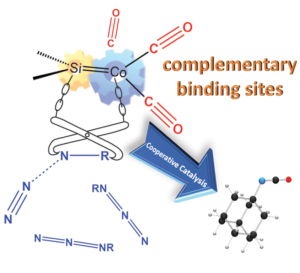
We are so excited that our recent work demonstrating a powerful new approach to catalysis using metal/main-group bonds has been published in Angewandte Chemie! We show that an unsaturated Co=Si (cobalt silylene) linkage provides two distinct and orthogonal sites for substrate binding, allowing nitrene-group transfer from an organic azide to carbon monoxide while avoiding interference between the substrates since CO does not bind to silicon. Congrats to undergraduate students Wenlai Han ’23, Helen Jin-Lee ’23, Zach DiNardo ’22, Emma Watson ’23, and Jim Zhang ’18 for their fantastic work, and thanks to collaborator Prof. Dani Kohen!

Lots of new crystal structures

The hard work of CHEM 352 students last term has come to fruition! The awesome group of 9 lab students made and crystallized tons of new complexes as part of three different inorganic experiments, and now three of these structures have been published (LINK TO PAPER) in Acta Crystallographica. This work follows up on several years of experiments by CHEM 352 students exploring solid-state characteristics of Mo(II) acetyl complexes, extending to a series of propionyl complexes featuring differently substituted triarylphosphine ligands. Congrats to Margaret Ball ’21, Alison Block ’22, Ben Brewster ’22, LouLou Ferrer ’22, Helen Jin-Lee ’23, Colby King ’22, Jamie North ’21, Inger Shelton ’22, and David Wilson ’22 for their excellent work!

Bimetallic small-molecule reductions

We are so excited that our recent work, showing a really cool and distinct approach to reducing small molecules like CO2 and ethylene, has been published in Angewandte Chemie! These findings show a really fascinating way that silylene ligands can template multimetallic redox reactions, and we think they may be extended more broadly to a variety of 3d metals. Congrats to students Jim Zhang ’18, Jason Ma ’18, and Anna Conley ’20 as well as collaborators Prof. Dani Kohen and Prof. Daron Janzen for their awesome work!!

New Paper

We just published a paper with collaborators at Davidson College in Acta Crystallographica.  The manuscript examines differences between related molybdenum acetyl structures featuring the PTA ligand and its diaceylated DAPTA variant.  Shout out to Prof. Mitch Anstey for identifying PTA as an interesting target for these studies and special thanks to his students at Davidson for excellent work!